There’s a quiet problem unfolding inside enterprise marketing teams right now.
Output is up. Way up.
More emails. More campaigns. More content across every channel.
And yet—performance isn’t keeping pace.
Generative AI has made it possible to produce marketing at a scale and speed that would have been unthinkable just a few years ago. Most teams have embraced it.
They’ve invested in the tools, trained their teams, and built AI into their workflows.
On paper, this should be a golden era for marketing productivity.
So why are so many teams seeing diminishing returns?
Because speed is no longer the constraint.
Judgment is.
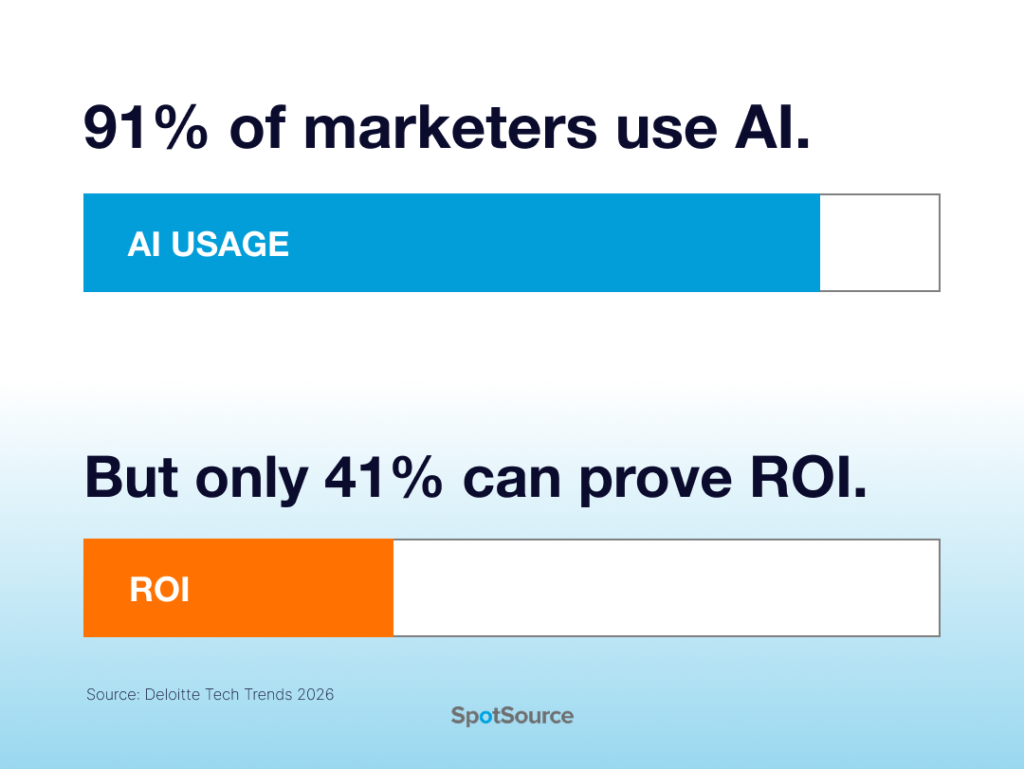
According to recent industry data, AI adoption in marketing is nearly universal—yet less than half of teams can clearly tie it to ROI. That gap isn’t a tooling issue. It’s what happens when production scales faster than strategy, and when automation outpaces the human insight required to guide it.
The result is subtle, but dangerous:
- More content that feels interchangeable
- More personalization that feels performative
- More activity that doesn’t translate into meaningful growth
This isn’t an AI problem.

It’s a control problem.
And in most organizations, it’s getting worse—not better.
The Risk No One Is Talking Enough About: Brand Erosion
Most of the AI anxiety in marketing has focused on job loss and automation. Valid concern—but it’s pulling attention away from a quieter, more immediate threat: brand erosion.
When automation runs ahead of human oversight, brands don’t just risk waste. They risk becoming forgettable, or, worse, annoying.
What erodes first isn’t headcount. It’s:
- Relevance. Your lifecycle emails now sound like every other SaaS company your customer hears from. Nurture sequences blur together. Social posts read like they were pulled from the same generic playbook. The sharp, specific point of view that once set you apart gets averaged out by the algorithm.
- Trust. What’s labeled as “personalization” often feels like surveillance. Subject lines mirror private behavior a little too closely. “Tailored” messaging reads like it was stitched together by a machine—because it was. Customers can’t always say why, but they feel the disconnect and pull back.
- Connection. Customers stop feeling understood and start feeling processed. In B2C, they quietly unsubscribe or scroll past. In B2B, they disengage from your sales teams faster, take fewer meetings, and become more price-driven because the relationship equity just isn’t there.
This doesn’t break your metrics overnight. That’s what makes it dangerous. By the time open rates soften, reply quality drops, or pipeline starts to feel “off,” the trust damage has already compounded across thousands of automated touchpoints.
Why “AI vs Human” is the Wrong Binary
The “AI vs. Human” framing has shaped too much of the industry conversation. However, it may be the wrong lens entirely.
The most effective marketing organizations aren’t choosing sides. They’re making explicit decisions about where AI is allowed to operate and where it’s not.
AI should handle the work that is:
- Repeatable
- High-volume
- Data- and pattern-driven
Humans need to own the work that is:
- Context-sensitive
- Brand-defining
- Relationship- and risk-heavy
In practice, that means:
- First-touch messaging in complex B2B cycles stays human-led. Cold outbound, executive outreach, and C-level nurture sequences should be drafted, reviewed, or heavily shaped by experienced marketers and sales leaders—not left to a model guessing at tone.
- Strategic narratives, positioning, and key value props are never fully delegated. AI can help explore angles and synthesize inputs, but it shouldn’t define the story your brand takes to market.
- AI is constrained to versioning, localization, and testing. Turning a core narrative into channel-specific variants, A/B subject lines, and regionalized copy is exactly where automation shines—within tight strategic guardrails.
This is particularly relevant for enterprise marketing leaders managing large agency rosters and complex multi-market campaigns. AI can accelerate briefing, budget modeling, performance reporting, and agency matching.
But the decision of which agency truly understands your brand, which message resonates in a specific cultural context, and which partnership is worth deepening. Those calls still require experienced human judgment backed by clean, accessible data.
The Questions Every Marketing Leader Should Be Sitting With
If you’re responsible for marketing performance at scale, these aren’t hypothetical questions. They’re operational ones that deserve honest answers:
- Where has automation made us faster, but not actually better? If you can’t clearly show how AI-driven campaigns are improving engagement quality and downstream conversion—not just content volume—you’re likely overproducing low-impact content that trains your audience to ignore you.
- Where is “personalization” actually eroding trust? If you’re not regularly auditing automated touchpoints from the customer’s point of view, your “smart” sequences may already feel creepy, hollow, or off-key. When that happens, unsubscribes and spam complaints are lagging indicators of a deeper trust issue.
- Where do we need our best people back in the loop? If you don’t know which moments in the journey absolutely require a human voice—C-level outreach, renewal risk, strategic upsell, partner communications—you’re probably letting AI fill critical relationship gaps by default, not by design.
These aren’t questions you answer once on a slide. They’re ongoing calibration work. The teams that treat them as a discipline will use AI to sharpen their edge. The ones that don’t will use AI to scale their weakest habits.
The Real Competitive Edge Has Shifted
A year ago, simply “using AI in marketing” sounded advanced. Today, nearly every enterprise team has access to similar tools. The advantage is no longer tool access. Instead, it’s how intelligently you direct those tools.
That means having the right people in place, the right agency partners to fill capability gaps, and the right operational infrastructure to move quickly without creating chaos. It means building systems where AI accelerates repeatable work, and where your people have clear visibility and control over the decisions that shape brand and customer trust.
For enterprise marketing leaders, that infrastructure increasingly includes how they manage their agency ecosystems.
The speed and quality of your agency activation, the clarity of your briefing process, and your ability to match the right partner to the right project without months of internal back-and-forth, these are now direct contributors to whether your AI investments translate into real marketing performance.
In a word: if AI is accelerating production but your agency activation is slow, your briefs are vague, or your partner matching is ad hoc, you aren’t scaling performance. You’re scaling noise.
What This Means in Practice
The brands that will win the next phase of AI-driven marketing aren’t the ones who automate the most. They’re the ones who automate with the most clarity about what should—and shouldn’t—be handed to a model.
That requires marketing leaders who are willing to audit their current stack honestly, invest in human expertise where it matters most, and build operational systems that give them visibility and control at speed.
AI is already scaling your marketing. The question is whether it’s scaling what actually makes your brand valuable—or slowly erasing it.
SpotSource helps enterprise marketing teams activate the right agency partners faster—with pre-vetted, procurement-approved agency roster visibility and AI-powered tools designed to support human decision-making, not replace it. Get a free demo at spotsource.com.