Most new CMOs arrive with an agenda. A point of view on the brand. A shortlist of agencies they’ve worked with before. Ideas they’ve been waiting to execute.
The ones who last don’t start with any of that.
The best marketing leaders understand something counterintuitive: the first 90 days aren’t about moving fast. They’re about making sure that when you do move, everything moves with you.
The difference between a CMO who builds something durable and one who flames out in 18 months often comes down to what they did — and didn’t do — in those first three months.
Here’s the framework that separates them.
Days 1-10: Listen before you diagnose
Before touching strategy, briefing an agency, or restructuring anything, your first priority is to map the landscape.
This means resisting the pressure — internal or self-imposed — to demonstrate immediate value through visible action. The most dangerous thing a new CMO can do is arrive with answers before understanding the questions.
In the first ten days, the work is diagnostic:

- Who are the real decision-makers, not just on the org chart but in practice?
- Where are the operational slowdowns that nobody talks about in all-hands meetings?
- What has already been tried and failed, and why? What has succeeded and why?
- How are we measuring success?
- What informal agreements or legacy relationships shape how work actually gets done?
- How has marketing communicated up to the rest of the C-suite, especially the CFO, CEO, and COO, and was it in the format the C-suite understands?
McKinsey research on executive transitions consistently points to one finding: leaders who take time to understand the existing system before attempting to change it are significantly more likely to drive lasting improvement. Diagnosis before prescription isn’t a delay. It’s due diligence.
Your job in week one is to understand what you’re actually inheriting.
Days 11-20: Audit the agency roster
Not the campaigns. Not the creative. The agencies themselves.
This is one of the most consistently neglected steps in a marketing leadership transition, and one of the most consequential. Most incoming marketing leaders inherit an agency roster they know nothing about: who’s on it, who’s actually being activated, what they’re contracted for, and whether anyone has reviewed performance in the last year.
The questions that need answers at this stage are deceptively simple: Who’s on the roster? Not just the 5 agencies we spend the most with, but who is actually being used? Who hasn’t touched a brief in 6 months but is still on contract and collecting retainer fees?
The answers are rarely clean. Large enterprise marketing functions often carry significant agency sprawl — vendors added over time by different teams, in different regions, for different projects, with no central view of the full picture. After all, the average enterprise marketing function works with dozens of agency relationships, many of which exist outside any formal procurement process.
This is the first problem, and it exists before you even look at the quality of the work those agencies are producing.
Getting clarity on the roster isn’t about cutting agencies. It’s about knowing what you have before you decide what you need.
Days 21-30: Meet procurement before you need them
This step is where many marketing leaders make their first significant political miscalculation: they treat procurement as a later-stage concern — something to loop in once strategy is set and agency selections are made.
That approach creates friction that’s entirely avoidable.
Procurement isn’t your adversary. For a new CMO, they’re actually your cover. They hold institutional knowledge about vendor approvals, compliance requirements, contract structures, and the specific triggers that can escalate a decision from operational to political. Understanding how they work — and building a relationship before you need something from them — changes the dynamic entirely.
In days 21 to 30, the goal is to understand their process from the inside. How do they approve new vendors? What does compliant engagement look like from their perspective? What are the common points of friction with marketing, and why? What triggers an escalation?
Once you know the answers, you can build your workflow around procurement’s requirements rather than against them. That’s not compromise. It’s leverage.
A CMO who has procurement aligned is one who can move faster when it counts, because the approvals aren’t a surprise.
Days 31-45: Identify where your team is losing time
By this point, you have enough context to start asking a different category of question: not what the team is working on, but what’s slowing them down.
The honest answer is almost never the creative work itself. It’s the coordination infrastructure around it.
Where are briefs getting stuck before they reach agencies? Who is chasing approvals in their inbox instead of managing projects? How much collective time is the team spending trying to find the status of purchase orders and payments? How many hours per week are lost to status meetings that exist only because no one has visibility into what’s actually happening?
Operational drag is invisible until you look for it, and it becomes normalized faster than most leaders realize. A process that was supposed to be temporary becomes standard. A workaround invented by one person becomes the way the whole team operates. By the time you inherit it, no one questions it anymore.
Research from Gartner on marketing operations consistently identifies coordination overhead as one of the primary drains on marketing team productivity, with teams reporting that a significant portion of their working hours are spent on administrative and coordination tasks rather than value-generating work.
Finding that drag now, before it becomes part of your organizational identity, is one of the highest-leverage things a new CMO can do.
Days 46-60: Set the standard for how projects run
Once you’ve identified the gaps, the instinct is often to solve them with tools. A new project management platform. Another integration. Another system that the team has to learn.
Resist it. At this stage, the gaps are rarely a technology problem. They’re a process problem, and the solution is clarity, not software.
The questions worth codifying are straightforward: How do we brief an agency? What does a complete brief look like, and who approves it? How do we track a project from kickoff to delivery? Where do decisions and documents live? How do we capture what worked at the end of a project, so the next team doesn’t start from zero? How do we report results up to leadership across many projects? Across many projects, what is the meaningful stat we can share with the C-Suite?
These aren’t complicated questions. But in most marketing functions, the answers are inconsistent — varying by team, by region, by agency relationship, by whoever happens to be running a given project.
The best marketing leaders operationalize their expectations early, so they don’t have to repeat them constantly. A clear standard, set at the beginning of your tenure, becomes the operating model that outlasts any individual project or campaign and feeds your own ability to assess progress and report up to the C-Suite.
Days 61-75: Run one flagship project the right way
This is where you stop building the system and start demonstrating it.
Pick one project — ideally one with enough visibility to matter but enough manageability to control — and run it as a proof of concept for the new way of working. A clear brief. The right agency selected with intention. A defined scope. Procurement involved from the beginning, not looped in at the last minute. One place where all updates, documents, and decisions live throughout the project lifecycle.
The outcome matters less than the process, at this stage. If the project succeeds, you have a model you can point to. If it surfaces problems, you have specific, real data on what needs to be fixed. Either way, you are building institutional credibility — demonstrating to your team, to procurement, and to senior leadership that you understand how work gets done and you’re raising the standard for it.
One clean project run well does more for your internal reputation than a dozen initiatives announced but poorly executed.
Days 76-90: Build the visibility layer
By day 90, a CMO should be able to answer three questions without hunting for data:
What agencies are we working with, and what are they doing right now? Where are our active projects, and are they on track? What have we spent, and what are we getting for it?
If you cannot answer those three questions cleanly — from a single source, without pulling reports from multiple systems or asking around — then you don’t have an agency ecosystem. You have a collection of relationships. That distinction matters enormously when you need to make decisions quickly, brief a new executive, respond to a budget question from the CFO, or defend a supplier relationship to legal or procurement.
Visibility isn’t a reporting function. It’s an operational foundation. And it’s one that most marketing functions haven’t built, because no one made it a priority during the last leadership transition.
The trait that earns long tenures
The CMOs who last — who build functions that outlive any single campaign cycle — share one consistent behavior: they build systems before they build campaigns.
Not because they’re cautious or slow. Because they understand something most of their peers learn too late: speed without structure doesn’t scale. It just generates more chaos to manage, more fires to put out, more political exposure every time something goes wrong.
The counterintuitive truth is that control enables speed. Governance enables creativity. Standardization enables scale. The CMOs who invest the first 90 days in building a solid operational foundation are precisely the ones who move the fastest in month six, year two, and beyond — because they’re not constantly rebuilding from a shaky base.
The first 90 days aren’t about making your mark. They’re about building the conditions under which your best work becomes possible.
For marketing leaders ready to make impact
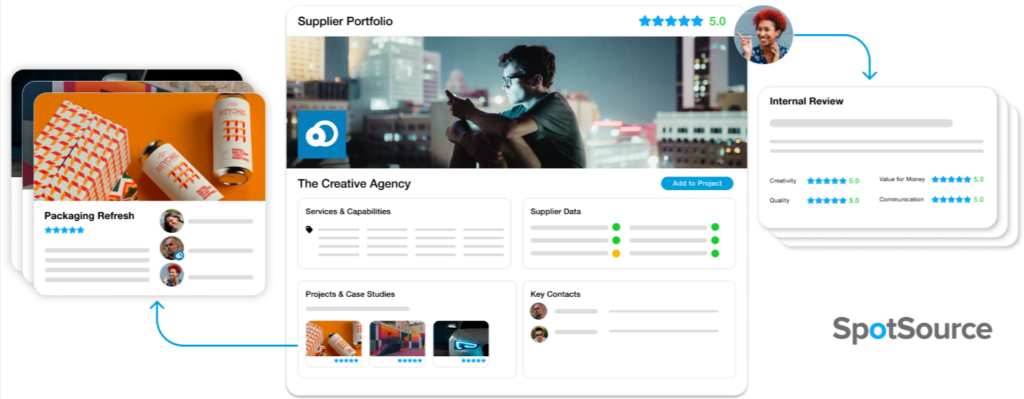
Most marketing leaders reach day 90 still hunting across inboxes, shared drives, and disconnected systems to answer basic questions about their agency relationships. SpotSource was built to close that gap, giving marketing and procurement a unified view of the roster, active projects, and spend, without the manual work.
Explore SpotSource by requesting a free demo today.