Enterprise marketing doesn’t stall because there aren’t enough agencies. It stalls because, when a real decision has to be made, no one can see clearly enough to choose the right partner with confidence and proof.
Six weeks to launch, and you’re about to bet your timeline on a question nobody can answer cleanly.
A regional lead pings: “Who do we use for a product launch push in APAC?” You should be able to respond in minutes. Your company already has a roster. Procurement already has approved vendors. Someone in Singapore probably solved this exact problem last quarter.
Instead, it turns into a Slack scavenger hunt. Names fly. Someone forwards a deck from 2022. Another person says “I’ll ask around.” No one can say, with proof, “Use this partner. They’ve done this job in this region, for one of our other brands, and here’s how it went.”

That’s the real issue. Enterprises are not short on agencies. Even after consolidation, the largest brands still operate with huge ecosystems of partners.
They’re short on visibility. The ability to find the right agency inside the approved supplier ecosystem fast, filter for fit, and make the call based on internal evidence instead of who happens to remember a name.
What Agency Visibility Actually Means in Enterprise Marketing
“Agency visibility” sounds abstract until you’re accountable for a decision that has to happen fast.
In an enterprise, visibility is not about knowing who exists on a roster. It isn’t about the handful of agencies you spend the most with in a year. It’s about whether the organization can reliably surface the right partner, at the right moment, without relying on memory or escalation. When that breaks, teams slow down even when the talent already exists.
In practice, visibility comes down to three things:
1. Findable
Visibility means narrowing quickly by capability, region, category, and brand experience. Not from hundreds of agencies to dozens, but from hundreds to a handful that actually fit the situation. That matters because speed pressure is real, time is limited.
In recent research on agency models, 92% of enterprise brands said greater speed is a priority, yet discovery still happens largely through informal channels.
In fact, 75% of marketers say they still find agencies primarily through word of mouth, not through structured systems. When urgency rises, anything that requires asking around becomes a bottleneck.
2. Safe to Use Now
Even when teams know an agency exists, uncertainty about approval status slows everything down. Is the contract current? Has PII privacy risk been cleared? Can this partner be reused without starting a new review?
As enterprises push toward more centralized agency services, reuse is supposed to reduce friction, not create more of it. Yet many organizations lack a clear, accessible view of which partners are actually safe to engage.
This is why so many teams default to starting new reviews, even though the average agency review takes more than three months and involves dozens of stakeholders. When approval status is visible up front, marketing can move without creating downstream cleanup.
3. Verified Past Performance
Confidence comes from proof, not positioning. The problem is that performance evidence rarely lives where sourcing decisions happen. Many organizations still lack consistent, quantitative ways to evaluate third parties.
Deloitte’s research shows that only 25% of leaders use quantitative scoring methods to assess third-party performance. As a result, insight lives in postmortem documents or quarterly business reviews (QBRs) on someone’s laptop or a shared folder or in individual inboxes.
When performance history isn’t attached to the supplier’s record, teams fall back on familiarity or the “safe” incumbent, even if that isn’t the best choice and costs considerably more.
When these three conditions aren’t met, visibility doesn’t fail because teams are careless. It fails because the system can’t answer real questions at the speed enterprise marketing now demands.
What Lack of Agency Visibility Actually Costs Enterprise Marketing

If visibility were just an operational annoyance, teams would live with it. The problem is it changes outcomes. It quietly taxes speed, quality, and governance in ways that show up later as missed launch windows, repeated work, poor results, and avoidable risk.
Here’s what it typically costs.
Slower Time-to-Market
When teams cannot find the right agency inside the roster, they default to the slow path: asking around, rebuilding a shortlist, and often triggering bringing in agencies from outside the approved suppliers.
That adds real time. Agency reviews routinely take three months or more, and even just being pulled into that process has operational consequences. In one major study, 25% of marketers said agency reviews delayed a campaign or product launch.
The cost here is not the review itself. It’s the quarter you lose while the market keeps moving.
Duplicate Onboarding and Repeated Vetting
Invisibility creates a weird pattern: enterprises can have thousands of approved suppliers and still behave like they have none, because nobody can see what is safe to reuse. Teams do not have visibility with data they can trust, so they ignore what they have.
That’s why teams end up going outside the approved suppliers and googling for a new agency to bring in, ignoring the partners that have already been through the system. It is also why vendor lists get bloated.
Research shows 20–30% of registered suppliers in enterprise procurement systems see no spend year-on-year, which is a signal that large parts of the “approved universe” are effectively dead weight.
Even when the right partner is already there, the organization pays again to rediscover them or to bring in a replacement for them because they do not even know the partner in the system exists as a perfect fit.
“Safe Choice” Bias (Rehiring the Same Agencies)
When proof is hard to find, the known option wins. That is not a strategy. It’s a visibility failure.
The data is blunt: 66% of brands that conduct agency reviews keep the incumbent, and when the incumbent participates, they win most of the time.
Sometimes that’s the right call. Often, it’s simply the easiest, but most expensive call. The best specialist for the job may be sitting, invisible, somewhere in the roster, and the decision makers have no way of knowing it.
Inconsistent Work Across Brands and Regions
Visibility failures create inconsistency and poorer results in a predictable way.
One region uses Agency A for a product launch, another hires Agency B for the same type of work, and a third builds an in-house solution. They are all solving identical problems differently, with no way to compare costs, quality, or outcomes across the system. Leadership can’t see which approach worked best, so the pattern repeats.
When you cannot reuse what works, every team reinvents the wheel. Brand execution drifts. Learns and the best results do not travel. Over time, that shows up as uneven quality and duplicated effort, not because people are careless, but because the organization cannot spread proven partners across teams.
Higher Odds of Off-Contract Engagements
The riskiest moment is the first moment, when someone decides who to hire.
If discovery happens in a Teams chat threads, Google searches, and referrals, teams naturally end up outside the approved agencies. That is the same dynamic behind maverick spend in procurement.
Organizations lose up to 16% of negotiated value when buying happens outside the system, and the biggest driver is not malice. It is friction. When the guided path is missing, people route around it.
Visibility is governance. Not in a policing sense, but in a practical sense: if teams can see and reuse approved partners quickly, off-contract behavior becomes the exception instead of the norm.
SpotSource: Behind High-Performing Enterprise Marketing Teams
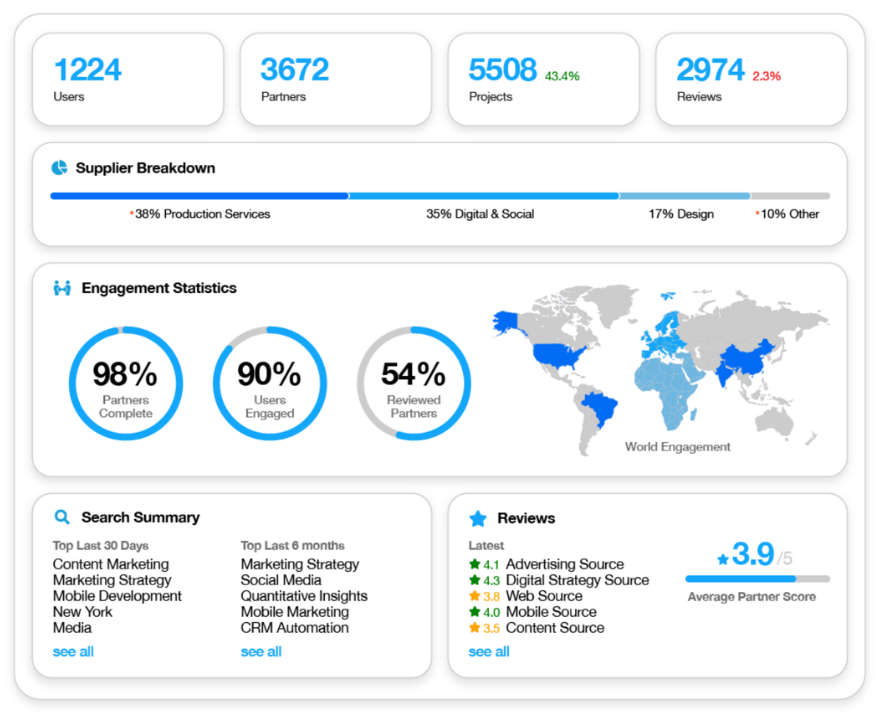
High-performing enterprise marketing teams do not “manage agencies better.” They build a system where the best partners become easy to find, easy to reuse, and hard to misuse.
This is the shift SpotSource was built around. Not another vendor list. Not another scorecard that lives in a deck. A system of record for the marketing ecosystem that makes better decisions easier in the moment they have to be made.
Here’s what the best teams do differently, framed as principles.
1. Shared Visibility at the Moment Of Sourcing
Top teams do not treat visibility as a quarterly cleanup project. They treat it as an operating capability.
They make partner discovery work like search, not like archaeology. When a campaign owner starts sourcing, the roster is already usable: filterable by capability, region, category, and prior brand experience. The result is that discovery happens inside the approved ecosystem, not outside it.
This matters because speed pressure is not a future concern. It is already a requirement. Most enterprise brands say speed is a priority for where agency models are going. SpotSource is designed so that speed comes from clarity, not from shortcuts.
2. Guardrails Before Commitment
The best teams do not bolt governance after kickoff. They surface it early, while choices are still reversible.
In SpotSource, “approved” is not a label on a spreadsheet. It is a visible context in the supplier sourcing process. Contract status, required documents, and any governance checkpoints show up before the team commits spend or starts work. This is how you prevent the classic enterprise failure mode where procurement finds out after the fact and everyone scrambles.
That early visibility aligns with where governance is heading more broadly. Boards and regulators are increasingly pushing for stronger transparency and oversight in third-party relationships, which makes late-stage governance harder to defend.
3. Performance Captured as Competitive Advantage
Top teams stop treating performance knowledge as disposable. They capture it so every engagement makes the next decision easier.
In SpotSource, outcomes and internal feedback become part of the partner record. Not as a punitive scorecard, but as searchable proof: what was done, who ran it, how it performed, and what to do differently next time.
This structured performance data doesn’t just help humans make better decisions, it becomes the foundation for AI-powered insights that can surface patterns, predict fit, and recommend partners based on past success in similar situations.
Gartner has reported that a large majority of CMOs experienced campaign performance issues in the last year. If performance is that volatile, your ability to reuse what works, and avoid repeating what did not, becomes a competitive advantage. And when that knowledge is structured and searchable, AI can help you learn from it faster than any human could manually review hundreds of past engagements.
4. Adoption Driven by Usability
The best systems win because people actually use them.
This is where most enterprise efforts fail. They are driven by procurement to create a compliant process that feels slower than “asking around,” and then they wonder why local teams bypass it. Procurement research is clear that when guided buying and self-service are missing, maverick behavior rises. People route around friction.
SpotSource is designed around the opposite principle: the compliant path should be the fast path. If a marketer can get to a defensible shortlist faster inside the system than outside it, adoption becomes natural. Governance improves because it is built into the workflow people prefer, not forced on them afterward.
A 3-Minute Assessment to Identify Marketing-Procurement Gaps
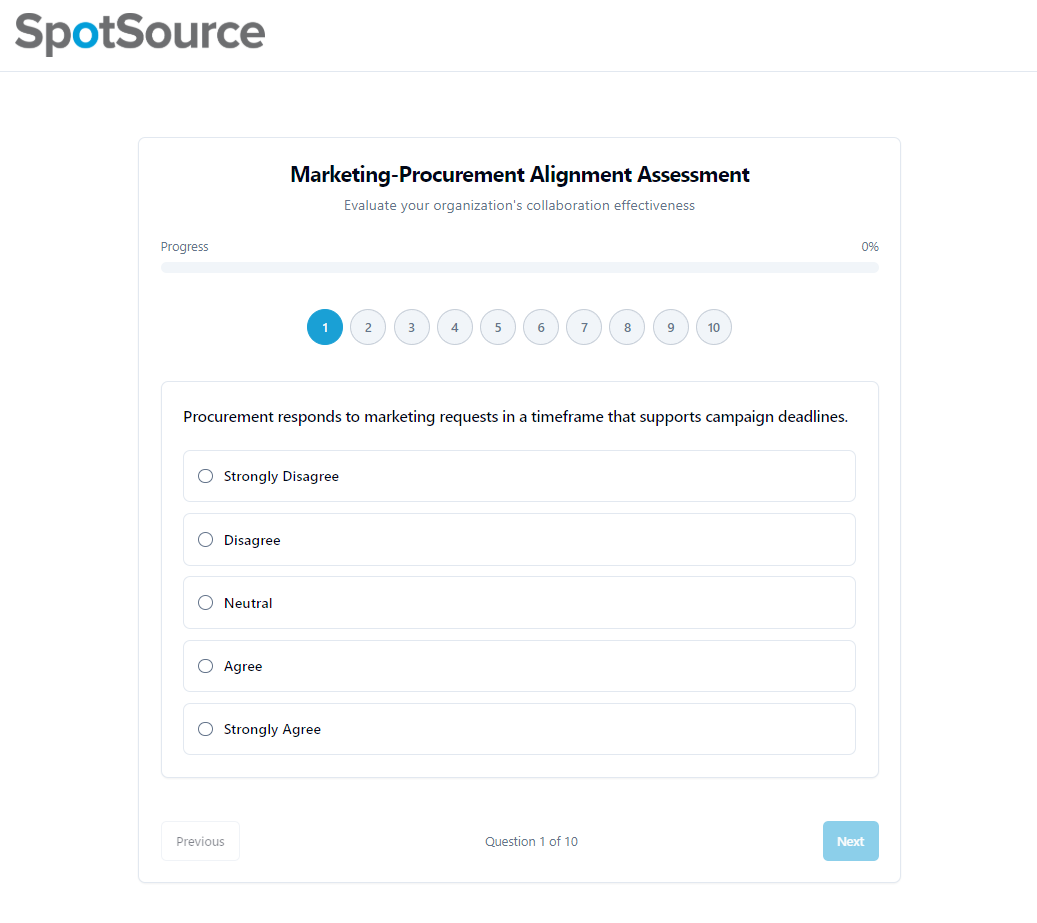
Skip the big initiative. Start with a 3-minute reality check.
Take the Marketing-Procurement Alignment Scorecard to see where collaboration actually breaks down, plus what to fix first. You’ll get an overall alignment score with a simple breakdown across Communication, Process Alignment, and Trust & Collaboration, then practical recommendations you can act on right away.
FAQs
Why can’t enterprise marketers find the best agencies they already have?
Because most “agency rosters” are stored as static lists, PPTs, or SharePoint pages that are not built for fast discovery by capability, region, category, and brand experience. When performance proof and approval status are not attached to the partner record, teams default to word of mouth and familiar incumbents instead of reusing the best-fit agency.
What does “agency visibility” mean in enterprise marketing?
Agency visibility means the ability to quickly surface the right agency for a specific job, confirm the agency is approved and safe to reuse, and make the decision using internal performance evidence instead of pitch decks or personal memory.
What are the biggest causes of the agency visibility gap?
Common root causes include rosters that function as lists instead of discovery systems, outdated tagging and categories, performance insight trapped in decks and postmortems, regional shortlists built in silos, and institutional knowledge loss when people change roles.
How does poor agency visibility slow down time-to-shortlist?
When teams cannot discover the right partner inside the approved ecosystem, they rebuild shortlists from scratch, ask around, or trigger new reviews. That turns a sourcing decision into weeks or months of coordination and delays campaign timelines.
Why do enterprises keep rehiring the same agencies even when they have better options?
When performance proof is hard to find, the “safe choice” wins. Teams reuse the agencies they remember because it feels lower risk than selecting a less-visible specialist, even if the specialist has better fit or stronger past results.
How does agency invisibility lead to off-contract or non-preferred engagements?
If discovery happens outside the approved flow (Slack threads, referrals, searching the web), teams are more likely to engage vendors before governance checks are visible. When the compliant path is slower than the informal path, bypass behavior becomes predictable.
What is the difference between an agency roster and a system of record for agencies?
A roster is typically a directory of vendors. A system of record makes agencies searchable by the way marketing actually buys, surfaces approval status and guardrails before commitment, and captures institutional memory like outcomes, reviews, and engagement history so future decisions get easier.
How do high-performing enterprise teams fix agency visibility without slowing marketing down?
They focus on four principles: shared visibility at the moment of sourcing, guardrails before commitment, performance captured as institutional memory, and adoption driven by usability so the compliant path becomes the fastest path.
What is marketing-procurement alignment and why does it matter for agency decisions?
Marketing-procurement alignment is how well both teams collaborate on selecting and reusing agencies with the right guardrails. When alignment is weak, sourcing decisions require escalations, approvals show up late, onboarding repeats, and off-contract risk increases.
How can I measure marketing-procurement alignment quickly?
A fast way is to use an alignment scorecard that produces an overall score plus category breakdowns (communication, process alignment, trust and collaboration) and gives practical recommendations for what to fix first.