AI is about to make your organization’s invisible knowledge a lot more important. Not because AI creates new demands on your marketing operation, but because it inherits the old ones — instantly, and at scale. Whatever your organization can already see about its own agencies, campaigns, and decisions, AI can use. Whatever it can’t see, AI will guess at, confidently.
Which is why AI doesn’t eliminate the need for marketing infrastructure. It makes the quality of that infrastructure more consequential. Enterprise marketing leaders are about to pour AI into the same fragmented operating environment that already slows human decision-making down — and expect a faster, better result out the other side.
Our last piece argued that AI isn’t the advantage — control is. This one advances that idea a step further: control requires context.
AI Doesn’t Have a Data Problem. It Has a Context Problem.
Most enterprise marketing organizations already have plenty of data. What they don’t have is context — the layer that turns a fact into something a decision can be made on.
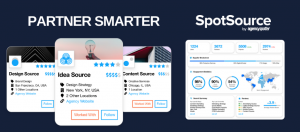
There’s a difference between knowing that Agency X worked on Campaign Y in Germany, and knowing that Agency X was rated highly for strategy but weak on production, had a strong local team, was already approved for the category, and — per another team’s findings — performed especially well with this specific audience. The first is a database entry. The second is what an experienced marketer actually draws on when deciding who to brief next.
That second layer is exactly what’s scattered across your organization right now — in email threads, agency recap decks, procurement systems, and the institutional memory of whoever ran the last project. It’s not missing. It’s just invisible to anything trying to reason across it, including AI.
The AI Readiness Gap Is Really an Operating Model Gap
The numbers confirm this isn’t a hypothetical concern. Gartner’s 2026 CMO Spend Survey found that 70% of CMOs name becoming an AI leader a critical goal, yet that same 70% admit their internal marketing processes aren’t mature enough to implement and scale AI effectively. Only about 30% report the organizational maturity to scale AI at all.
That’s not a technology gap. It’s an operating model gap, and it’s the same one we described last time. Martech stacks running 90–120 tools deep sit at roughly 33% utilization, and that underuse isn’t a licensing problem. It’s what happens when systems don’t connect, so nobody can see across them. Budget for AI is now being approved faster than the organizational context needed to make AI useful is being built.
Gartner’s own framing makes the mechanism explicit: clean, unified data is the foundation of any AI investment required to perform, and CMOs who layer AI onto fragmented systems accelerate noise rather than results. The organizations closing this gap aren’t the ones buying the most AI tools. They’re the ones who’ve already done the harder, less visible work of making their institutional knowledge legible.
Humans Can Work Around Fragmentation. AI Can’t.
A marketer facing a fragmented system has a workaround: dig through the shared drive, ping a colleague, remember what happened last time. It’s slow and it doesn’t scale, but it produces a grounded answer.
AI has no such workaround. Ask an AI system which agency to brief without giving it access to organizational memory, and it won’t return “I don’t know.” It will return something fluent, structured, and disconnected from what your organization has actually learned because it’s reasoning over whatever it can access, and treating the gaps as if they don’t exist. That’s the real risk of deploying AI into a fragmented environment: not that it fails visibly, but that it fails confidently, in a format that looks like insight.
This is why the fragmentation problem gets more expensive with AI in the room, not less. AI doesn’t route around missing context. It papers over it. So AI doesn’t reduce the need for a connected knowledge layer — it raises the bar for one.
What AI Could Do If Your Marketing Context Were Connected
Strip away the AI framing and these are just the questions a marketer already asks before every project. The difference is whether the organization can actually answer them.
Which agency? Instead of relying on whoever remembers the last comparable project, AI could surface the best-fit partner based on documented performance history, category approval, and regional strength — the same reasoning a seasoned marketer would do manually, done in seconds.
Have we done this before? Rather than starting a brief from a blank page, AI could draft a first pass grounded in the scope, learnings, and outcomes of comparable past projects, turning institutional memory into a starting point instead of a lost artifact.
Who performs best in this market? Regional and category performance patterns are usually buried across dozens of past engagements. Connected context lets AI surface them instantly instead of leaving the pattern to whoever happens to remember it.
Can we safely activate this partner? Before an agency is invited into a project involving sensitive data, AI could check contract status, risk approvals, and category clearance and flag anything unresolved before it becomes a problem instead of after.
AI Should Surface Decisions. Humans Should Govern Them.
None of the examples above should read as AI making the call. It shouldn’t. The compliance example is the clearest case: AI can flag a potential compliance gap before an agency is invited to a project requiring sensitive data, and then route it to the appropriate human owner for confirmation. AI surfaces. Humans govern.
This is the same principle our last article made about control: AI isn’t valuable because it replaces judgment, it’s valuable because it gets the right information in front of the person exercising judgment, faster and with more context than they’d otherwise have.
An AI-ready organization isn’t one that hands all decisions to AI. It’s one where AI does the work of making relevant context visible, and humans keep the authority they already have.
What “AI-Ready Marketing” Actually Means
Most AI-readiness conversations stop at models, security, and technical integration. Those matter, but they answer the wrong question. The question that actually determines whether AI will be useful in your marketing organization is simpler: can AI actually see what your organization knows?
If the answer is no, the model doesn’t matter. What’s missing isn’t data — it’s AI-ready context: organizational knowledge in a form an AI system can actually reason over. Six conditions determine whether you have it.
- Structured – the organization knows what the information represents, not just that it exists
- Connected – related pieces of context can be understood together, not read in isolation
- Current – the system can tell what’s still valid from what’s outdated
- Accessible – the right people, and authorized AI systems, can actually retrieve it
- Attributed – the organization knows where the information came from and how trustworthy it is
- Actionable – the information is structured in a way that can actually inform a decision or workflow
This is a higher bar than “clean your data.” It’s the difference between information existing somewhere and an organization actually knowing what it knows. Most enterprise marketing operations don’t have AI-ready context today; not because the information is missing, but because it was never built to be seen this way.
AI will amplify the quality of your organization’s decisions — but only if your organization can see what it already knows.
The Connective Layer Comes Before the AI Layer
The fix isn’t another AI tool competing for a slot in an already crowded stack. Adding one more node to a network that was never connected doesn’t reduce the fragmentation: it scales it, and gives it a more confident voice. What’s needed is the layer underneath: the one that turns agency context, briefs, performance history, and approvals into AI-ready context in the first place.
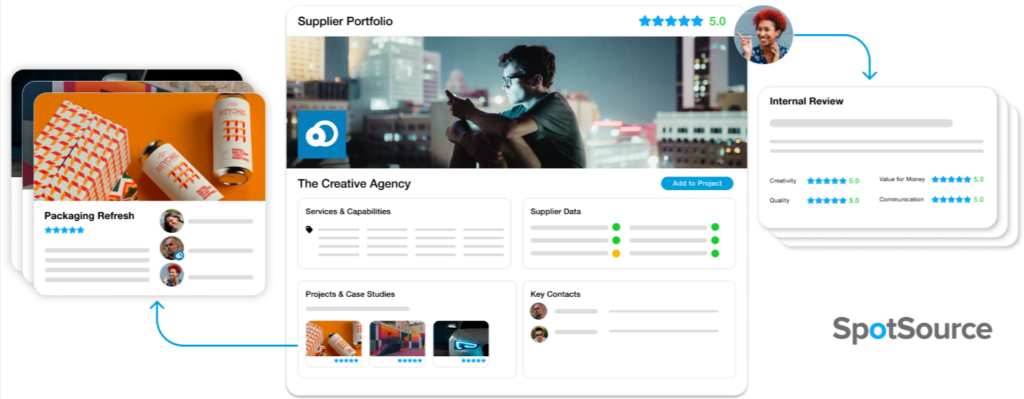
That’s what SpotSource is built to be: the operating system for your external partners, and the connective layer that makes everything built on top of it, including AI, actually work. Not a smarter chatbot bolted onto a fragmented stack, but the foundation that makes the stack legible enough for AI to be useful at all.
AI won’t solve an organization that can’t see what it knows. It will simply make decisions with whatever information it can access — and do it faster.
That’s why AI readiness isn’t just about choosing the right model or deploying the right tools. It’s about making the organization’s own knowledge visible, connected, and usable.
The next competitive advantage isn’t having AI. It’s giving AI something worth knowing.
And for enterprise marketing, that starts with connecting the context already buried across your agency ecosystem.