Enterprise marketing doesn’t slow down because of the budget. It slows down because no one can clearly see the partner ecosystem they already have. When agencies are approved, but not discoverable, performance lives in slide decks, and risk checks happen in separate systems, speed and governance collide.
Most Fortune 500 organizations already work with world-class agencies and service suppliers. What they lack is marketing ecosystem visibility: a shared, reliable view of who their partners are, what they are truly good at, what work they have delivered for the company, how they performed, and whether they are safe to reuse.
That blind spot is expensive. Rosters keep expanding with almost no reuse. Teams restart work the organization has already done. Onboarding is inconsistent. Partner selection falls back to whoever someone remembers.
This is why the internal marketplace model is gaining traction. Not because leaders want more vendors, but because they need a system that makes proven partners visible, reusable, and easy for marketers to choose with confidence.
The Hidden Cost of Partner Sprawl in Enterprise Marketing
Partner sprawl is not just “too many suppliers.” It is what happens when partner knowledge lives in inboxes, slide decks, and individual memory instead of a shared system.
Inside enterprise marketing, it typically looks like this:
- Single-use agencies hired for one campaign, then buried inside procurement systems and rarely reused
- Redundant service suppliers across brands and regions because teams cannot see what already exists
- Lost institutional knowledge when leaders rotate: why a partner was chosen, what they specialized in, what they delivered, and what the team learned
- Slow activation even with preferred lists, because preferred does not mean contract-active, risk-cleared, and payment-enabled inside the right system
- Inconsistent marketing partner governance, with uneven onboarding and risk checks that surface after work has already begun
Even when a marketer finds an approved supplier, the friction continues. Procurement still has to verify whether the contract is active, whether the right third-party risk approvals are in place, and whether the supplier is properly set up in the payment system. That validation often spans multiple tools. The marketer waits while systems are reconciled.
The scale of this fragmentation is larger than most leadership teams assume. In a 2024 third-party risk survey, 50% of respondents reported working with more than 100 suppliers. That is the operating environment behind most internal marketplace conversations.
The friction is structural, not temporary. Amazon Business reports that 95% of decision-makers see room to optimize procurement processes, and 85% say sourcing suppliers efficiently remains difficult. When sourcing stays complex, marketing defaults to familiarity instead of fit.
The pattern is predictable: more partners, more urgency, less shared context. Organizations move more slowly, not because they lack resources, but because visibility does not scale with growth.
Internal Marketplaces Are Moving Beyond Talent for One Reason: Ecosystem Visibility
This is where the talent marketplace story matters, but only as a precedent.
Talent marketplaces solved internal allocation: who has what skills, who is available, and how to deploy them quickly. They replaced informal networks with a system that leaders could trust.
External services never got that upgrade.
Enterprise marketing relies on a growing network of agencies and suppliers: creative, production, media, research, martech, analytics, localization, and experiential. The ecosystem gets larger, but visibility does not get better. So, teams keep behaving the same way: they hire who they know, repeat onboarding, and relearn the same lessons in parallel. This is a time-intensive and costly rut for companies to be stuck in.
The same logic that drove talent marketplaces is now applying to external partners:
- If you cannot see your marketing partner ecosystem, you cannot reuse it.
- If you cannot reuse it, you cannot standardize it.
- If you cannot standardize it, you cannot govern it without slowing teams down.
That is why more organizations are building an internal marketplace for external services. It is not a trend story. It is what happens when visibility becomes the constraint on speed.
How Enterprises Are Operationalizing Service Supplier Management With SpotSource
Most enterprise teams already have pieces of this: a vendor list, an intake form, a shared drive of “preferred” partners.
The issue is adoption. Those tools do not match how marketing operates and are often static with incorrect or out-of-date data, so teams route around them.
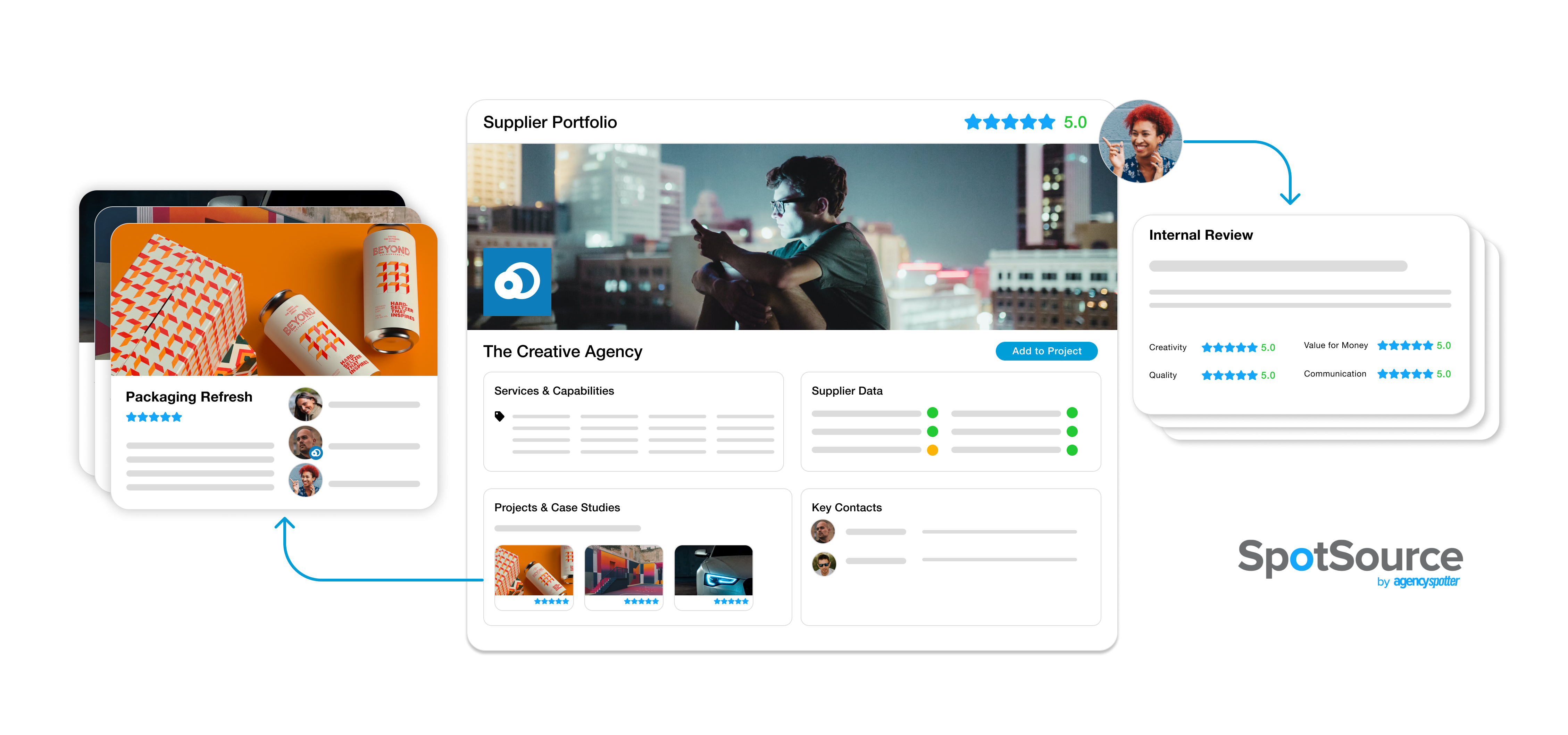
SpotSource is built to operationalize the internal marketplace, specifically for external marketing services, so it functions as a system of record for service supplier management and supplier governance.
It enables enterprise teams to:
- Build real marketing ecosystem visibility across regions, brands, and business units
- Activate agencies and service suppliers faster by avoiding repeat sourcing and re-vetting for known partners
- Drive reuse by making proven partners and repeatable engagement paths discoverable
- Turn performance into institutional memory, so partner selection improves over time
- Embed marketing partner governance into the workflow so procurement can trust it without slowing marketing
- Support vendor consolidation using context (usage, outcomes, and risk), not just policy
For marketing leaders, this is a speed and execution advantage. For marketing procurement, it is a control and risk advantage. For both, it is the same unlock: shared visibility that people actually use.
What an Internal Vendor Marketplace Actually Changes at Scale
The point is not “a portal for vendors.” The point is what happens when external partner engagement becomes institutional memory instead of tribal memory.
Faster Activation
An internal vendor marketplace reduces the time from “we need a partner” to “work has started” by making discovery and eligibility immediate. Teams stop restarting sourcing cycles. Procurement stops being pulled in as a last-minute gatekeeper because the workflow already reflects what “approved” means.
Higher Reuse
When marketing teams have ecosystem visibility, reuse becomes the default. Proven agencies and service suppliers are easier to find, so teams replicate what works instead of reinventing it. This is where real efficiency shows up: fewer duplicate suppliers, less ramp time, more repeatable execution.
Stronger Partner Performance
Most enterprises do not have a consistent feedback loop for external partners. A marketplace model creates a durable record of outcomes across teams and regions, so performance is not anecdotal. Leaders can answer questions that matter in executive reviews:
- Which partners deliver consistently?
- Where do engagements stall?
- Which work types produce repeatable results?
- Which relationships are strategic versus habitual?
This is the practical side of marketing partner governance: performance that can be seen, not just felt.
Real Vendor Consolidation (With Context)
Vendor consolidation fails when it is driven by lists instead of reality. A marketplace adds the missing context: actual usage, outcomes, risk history, and demand across business units. Consolidation becomes a consequence of visibility, not a mandate that teams work around.
Better Governance
Governance breaks when it lives outside the work in policy decks and approval chains. A marketplace embeds governance where decisions happen: selection, onboarding, contracting, and performance tracking. That is how marketing partner governance becomes consistent without turning every engagement into a slowdown.
Internal Marketplaces for Enterprise Marketing: Visibility, Reuse, Governance
An internal marketplace for enterprise marketing is not about finding more vendors. It is about replacing scattered vendor lists with an internal vendor marketplace that gives leadership real marketing ecosystem visibility.
When you can see your full partner ecosystem, you can reuse proven agencies, improve service supplier management, and strengthen marketing partner governance without slowing teams down. Speed stops competing with control because the workflow becomes the system of record.
Take the Marketing-Procurement Alignment Scorecard to see where collaboration is actually breaking down across communication, process alignment, and trust. In under three minutes, you’ll get a clear alignment score plus targeted recommendations to improve partner activation and reuse across your marketing organization.