What Is Marketing Ecosystem Visibility?
Why enterprise marketing leaders need more than an agency roster, vendor list, or dashboard
Ask a CMO how many agencies they work with and most can’t tell you. Not exactly. Somewhere between “a lot” and “we should probably audit that.”
That’s not a knock on them. It’s what happens when marketing turns into an ecosystem instead of a roster — dozens of specialist agencies, production partners, martech vendors, freelancers, regional shops, each one added for a good reason at the time, none of it ever fully mapped.
Here’s the part that should bother people more than it does: the organization usually already has the answer to whatever problem just landed on someone’s desk. It’s just not visible to the person who needs it.
Somebody, somewhere in the company, already knows which agency is great at retail media. Somebody already ran the RFP for exactly this kind of work last year. Somebody has the performance history that would save three weeks of due diligence. That knowledge exists. It’s just sitting in the wrong inbox.

I call this the visibility gap, and I think it’s the single most underrated problem in enterprise marketing right now.
Marketing ecosystem visibility is the ability to see, understand, and act on the capabilities, relationships, performance, and readiness of the external partners and agencies surrounding an enterprise marketing organization. It’s different from an agency roster or vendor list, which tells you who exists but not what you can actually do with what you already have.
Marketing stopped being simple a while ago
Early in my career, a brand’s agency roster was short enough to say out loud: a lead creative shop, a media agency, maybe a PR partner. You could hold the whole thing in your head.
That world is gone. Today a single enterprise brand might touch brand strategy, creative, media, social, influencer, performance, content, production, experience design, commerce, data, martech, AI tooling, research, and regional execution — each with its own specialists, and often its own agency.
Multiply that by every brand, market, and business unit a large company runs, and you get something that isn’t a roster anymore. It’s an ecosystem — a genuinely large, genuinely valuable network of external capability that the organization has spent years and millions of dollars building.
The trouble is, almost nobody can see the whole thing at once.
A roster is not the same thing as visibility
Plenty of enterprises have an impressive-looking agency roster. Two hundred approved names isn’t unusual. A spreadsheet will tell you those names. Procurement can tell you who has a signed contract. An agency’s own website will tell you what they claim to be good at.
None of that answers the only question that actually matters when a brief comes in:
Who is the right partner for this specific problem, right now?
That takes context a name-and-logo list can’t give you: Have we used them before? Which team, on which brand? What did they actually deliver, and how well? Would that team hire them again? Are they even approved and ready to go, or is there a compliance step waiting to blow up the timeline?
A roster tells you who exists. Visibility tells you what you can actually do with what you already have.
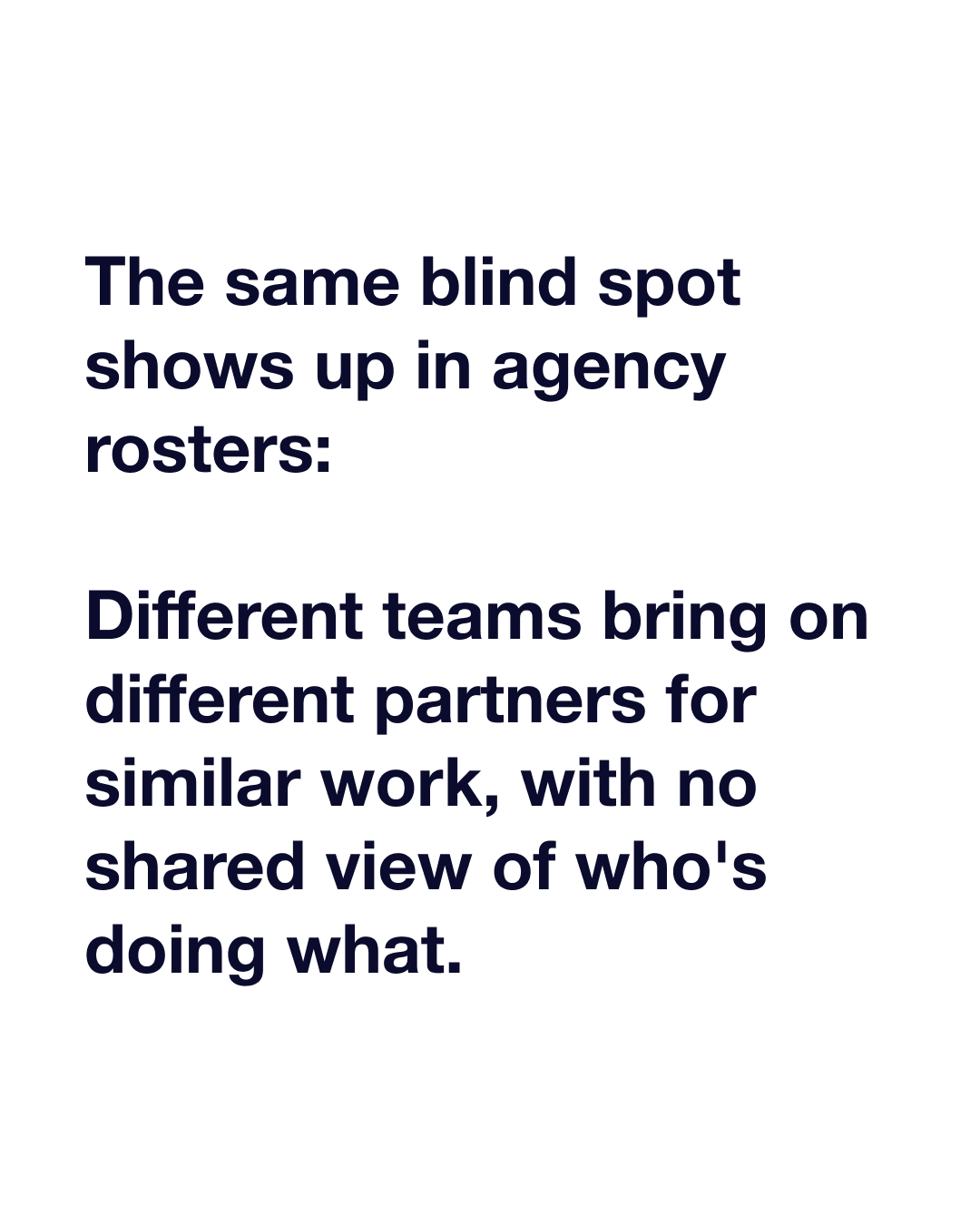
The problem isn’t necessarily that an enterprise has too many partners. It’s that different parts of the organization often experience those partners as if they belong to entirely separate companies.
A roster provides names. It doesn’t necessarily provide organizational visibility.
The five layers of marketing ecosystem visibility
I’ve come to think about this in five layers. Miss any one of them and the picture stays broken.
Discoverability — Can someone actually find the right partner? An agency being technically “on the roster” means nothing if it’s invisible to every team except the one that originally hired them.
Capability & context — A name isn’t information. What has this partner actually done, for whom, in which markets, on what kind of problem? That’s what turns a directory entry into something usable.
Readiness — A great-fit agency that isn’t contracted, compliant, or PO-ready isn’t actually available. Readiness gaps have a habit of surfacing right after the decision’s already been made — which is the worst possible time.
Performance evidence — Not the pitch deck. Not what the agency says about itself. What did the people who actually worked with them experience? Were they strategic? Did they deliver? This is the layer most organizations have — and almost never make accessible.
Institutional knowledge — The stuff that lives in people’s heads: “we used them in Europe and they were great,” “they struggled with global timelines,” “ask Sarah, she ran that project.” It’s real, it’s valuable, and it walks out the door every time someone changes roles.
What it actually costs you
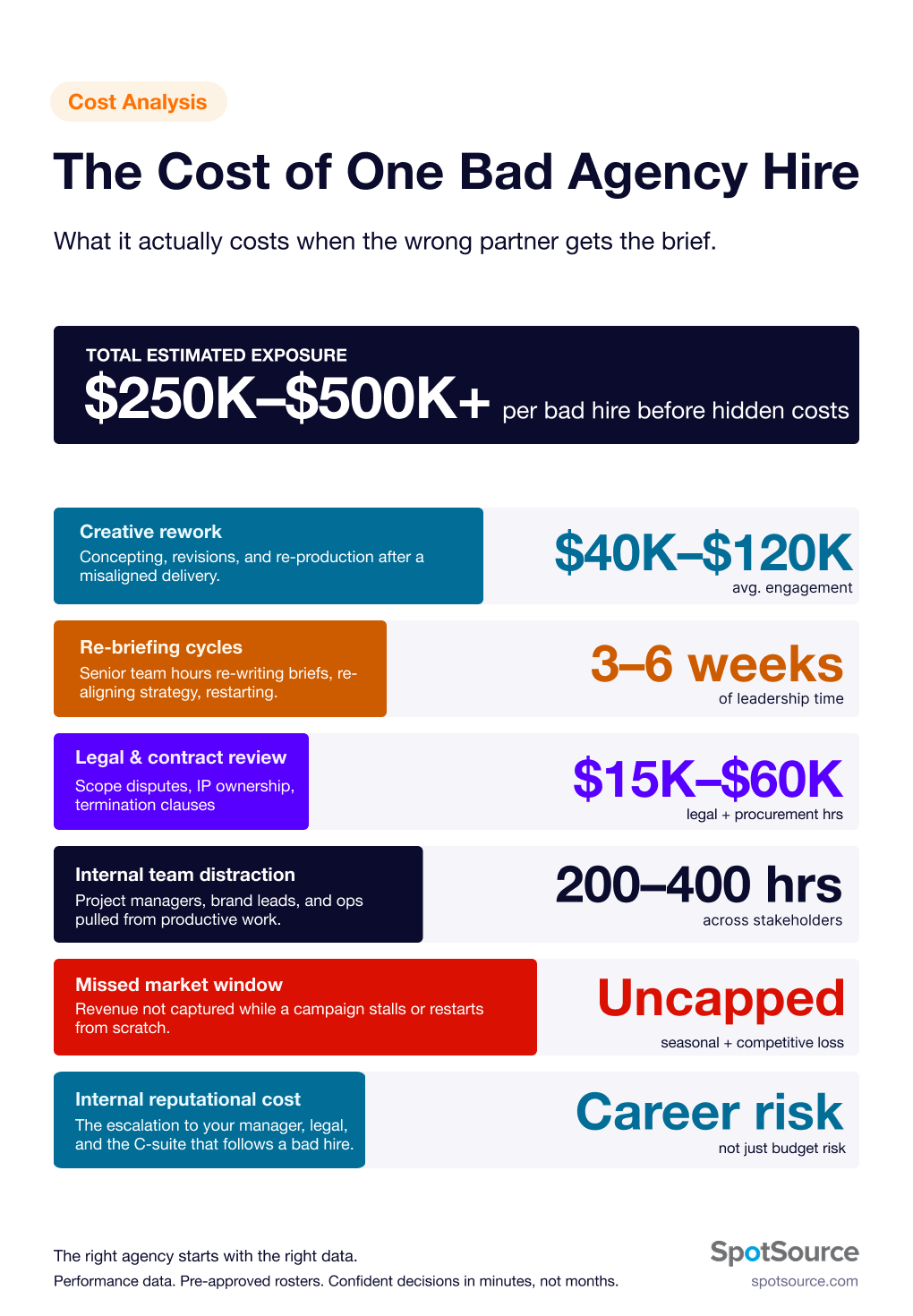
The obvious cost of poor visibility is time — the searching, the re-pitching, the re-running of due diligence someone else already did six months ago.
The real cost is worse. It’s the quality of the decisions the organization makes without the information it already owns:
- A new agency gets hired while an excellent one already exists, unused, two floors down.
- A regional team solves a problem another market solved last quarter — from scratch.
- A great agency relationship quietly disappears the day its internal champion leaves the company.
- Procurement gets looped in after the decision’s effectively made, instead of helping shape it.
None of that shows up on a budget line labeled “cost of poor visibility.” It shows up as slower, worse marketing.
Why this gets more important, not less, as AI speeds everything up
Here’s a paradox worth sitting with: AI is making production faster. It is not making organizations better at deciding who should do the work or what’s already been learned.
Give an AI system the ability to produce ten times the output, but no access to your organization’s actual history with its partners, and you’ve accelerated production without adding a shred of judgment. Speed just amplifies whatever’s already underneath it. Good infrastructure gets faster. Fragmented infrastructure gets fragmented faster.
More data isn’t the fix
Enterprise marketing organizations aren’t short on information. If anything they’re drowning in it — procurement systems, ERPs, spreadsheets, shared drives, inboxes, project trackers, old QBR decks, and whatever a regional team happens to remember.
Another dashboard doesn’t fix that. What fixes it is connecting the information that’s already there to the moment someone actually needs to use it.
Visibility isn’t having more information. It’s making the information you already have usable.
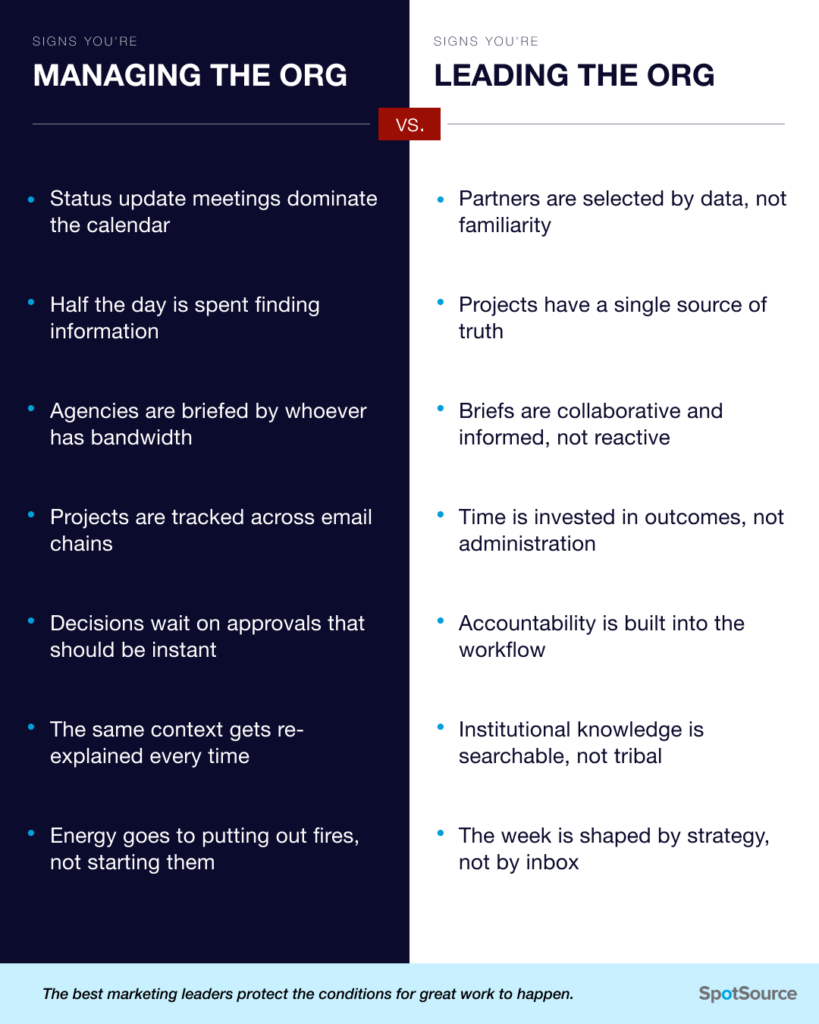
Marketing leadership is becoming ecosystem leadership
The org chart tells a CMO who works for the company. It has never told them who actually gets the work done. Increasingly, the most important capabilities sit outside that chart entirely — in agencies, production partners, technology vendors, consultants, regional teams, procurement, and now AI systems.
Running that well isn’t the same skill as running a department. It’s closer to running an ecosystem. And you can’t lead what you can’t see.
What this looks like in practice
A marketing leader with real visibility can answer, in the moment a brief lands: Who can solve this? Have we used them before, and how did that go? Is there someone already approved who’s ready to start Monday? Are we already paying for this capability somewhere else in the company?
None of that replaces judgment. It’s the opposite — it’s what good judgment needs in order to work.
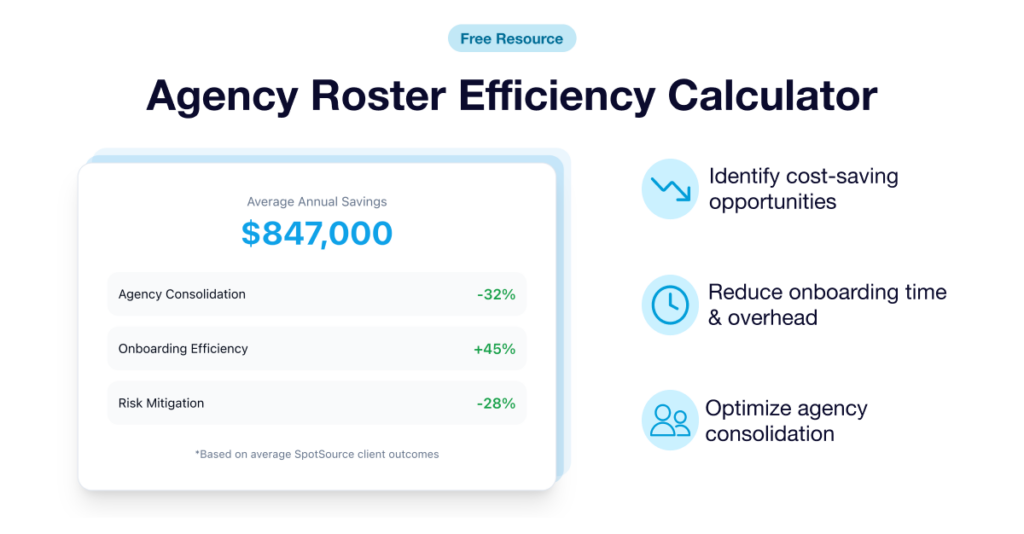
If you’re wondering how much hidden inefficiency might exist inside your own agency ecosystem, we’ve created a simple Agency Roster Efficiency Calculator to help estimate it.
Why I built SpotSource
I’ve spent more than two decades around agencies and the enterprise marketing organizations that hire them — including inside Coca-Cola’s marketing ecosystem — and I kept running into the same pattern: companies had built enormous knowledge about their own external partners, and almost none of it was usable when it mattered.
That’s the problem SpotSource exists to solve. It brings an organization’s external service-provider ecosystem into one place — capabilities, relationships, performance, projects, readiness — so marketing teams can see what they already have before they go looking for something new.
The goal was never to help someone find an agency faster. It’s to help an organization get more value out of the ecosystem it already built.
The bottom line
Enterprise marketing doesn’t need another directory. It doesn’t need a dashboard for the sake of having a dashboard. And more often than not, it doesn’t need another agency.
It needs to see what it already has.
The right partner may already be there. The performance history may already exist. The institutional knowledge may already be sitting in someone’s head three floors up. The only real question is whether anyone can find it in time to make a quality decision.
That’s not just an operational advantage anymore. It’s becoming a marketing performance advantage.
Frequently asked questions
What is marketing ecosystem visibility? It’s the ability to see, understand, and act on the capabilities, relationships, performance, and readiness of the external partners and agencies that make up an enterprise marketing organization. An agency roster tells you who’s approved. Ecosystem visibility tells you what you can actually do with what you already have.
What’s the difference between an agency roster and ecosystem visibility? A roster is a list of approved names. Visibility adds the context a list can’t offer: whether a partner has done this kind of work before, how they performed, whether they’re ready to start, and what the rest of the organization already knows about them.
What are the five layers of marketing ecosystem visibility? Discoverability, capability and context, readiness, performance evidence, and institutional knowledge. Miss any one of them and the picture stays incomplete — plenty of organizations have strong information in one area and almost none in the other four.
Why does marketing ecosystem visibility matter more as AI adoption increases? Because AI makes execution faster, not judgment better. Without visibility into who’s already been tried, what worked, and who’s ready to go, faster execution just means an organization makes uninformed decisions more quickly.
Who is responsible for marketing ecosystem visibility inside an enterprise? Usually marketing leadership and marketing procurement, together. Marketing needs it to make faster, better-informed partner decisions. Procurement needs it to manage spend, compliance, and risk. It works best when both sides are looking at the same information instead of two different systems.
About SpotSource SpotSource is an enterprise platform for managing and activating the external service-provider ecosystem surrounding marketing and other complex business functions. Learn more at SpotSource.com.